Surviving Clinical Placements: How Australian Nursing Students Can Balance Shiftwork and Case Studies
Undertaking a Bachelor of Nursing or a Master of Nursing practice at an Australian higher education institution is an exceptionally rigorous academic and vocational journey. Unlike standard theoretical degrees, nursing curricula demand that students seamlessly transition from high-level clinical bioscience lectures to direct, front-line patient care within the healthcare sector. The cornerstone of this professional transition is the clinical placement phase, during which student nurses work rotating rosters across public hospitals, private clinics, and aged care facilities.
However, the operational reality of clinical placements introduces a punishing triad of stressors: irregular shift work, physical exhaustion, and concurrent high-stakes academic deliverables. While managing a 40-hour weekly placement roster that includes morning, evening, and unpredictable night shifts, students are simultaneously tasked with drafting highly structured clinical case studies, reflective journals, and evidence-based practice portfolios. Without robust strategic systems, the risk of academic burnout and clinical error escalates exponentially. For individuals striving to retain top academic performance under these conditions, engaging a professional assignment service in Australia provides the precise empirical structure and editorial scaffolding required to preserve a high Grade Point Average (GPA) while fulfilling mandatory vocational hours.
Key Takeaways
- Roster Optimization: Synchronize your study cycles with your shift architecture using the “circadian alignment framework.”
- Real-Time Data Synthesis: Leverage de-identified clinical interactions immediately post-shift to establish the foundation of your case studies.
- Rigorous Adherence to Standards: Ensure every written submission aligns explicitly with the NMBA Registered Nurse Standards for Practice.
- Strategic Academic Support: Delegate secondary editorial tasks to dedicated subject experts to safeguard clinical focus and rest.
The Structural Architecture of the Nursing Student’s Dilemma
The Australian healthcare system operates continuously, requiring an adaptable workforce. For the student nurse, this means confronting the realities of modern shift work. A standard clinical placement rotation frequently mirrors professional nurse rostering, incorporating early shifts (0700 to 1530), late shifts (1330 to 2200), and night shifts (2130 to 0730). According to national workforce data, transitioning rapidly between these time blocks disrupts systemic circadian biology, triggering acute sleep debt and cognitive fatigue.
Simultaneously, the academic expectations imposed by Australian nursing faculties are uncompromising. A typical clinical case study requires the comprehensive analysis of a patient’s pathophysiological presentation, the formulation of a detailed nursing care plan, and an exhaustive justification of interventions rooted in contemporary peer-reviewed literature. Students are caught in a structural squeeze: the physical energy required to perform safely on the ward directly cannibalizes the cognitive reserves necessary to execute academic research and technical writing.
Circadian Study Mapping: Synchronizing Mind and Shift
To survive this intersection without compromising patient safety or academic integrity, nursing students must abandon haphazard study patterns and implement a systematic framework called Circadian Study Mapping. This method involves categorizing cognitive tasks based on the specific shift worked, ensuring that heavy analytical writing is never attempted during periods of peak sleep debt.
| Shift Configuration | Cognitive Energy Level | Optimal Academic Activities | Activities to Avoid |
| Early Shift (0700 – 1530) | Moderate Post-Shift Fatigue | Literature searching, reference compiling, database filtering (CINAHL/PubMed). | Drafting complex pathophysiology discussions or advanced clinical justifications. |
| Late Shift (1330 – 2200) | High Morning Alertness | Heavy structural drafting, case study outline generation, synthesis of nursing care plans. | Leaving writing tasks until late night after the shift concludes. |
| Night Shift (2130 – 0730) | Acute Sleep Debt / Circadian Low | Passive proofreading, formatting according to APA 7th style, updating bibliographies. | Attempting critical analysis, dosage calculations, or clinical reasoning summaries. |
By mapping your academic workload to your biological readiness, you avoid the phenomenon of “blank page paralysis,” where an exhausted student spends hours staring at a document without producing meaningful content. Instead, tasks are modularized, allowing for incremental progress across the placement block.
See also: How IoT Devices Are Reshaping Daily Life
Deconstructing the Clinical Case Study: A Data-Driven Approach
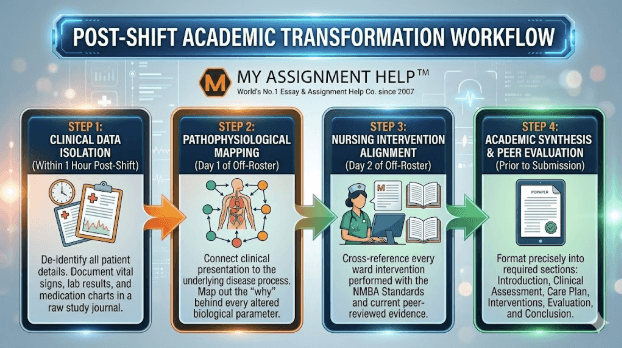
An exceptional nursing case study does not merely describe what occurred during a shift; it critically analyzes the underlying clinical mechanisms. To build a highly structured paper, students must actively execute a data-driven collection methodology while on placement—strictly observing patient confidentiality and institutional privacy policies.
When assigned a patient with a complex presentation (such as acute exacerbation of Chronic Obstructive Pulmonary Disease co-morbid with Chronic Heart Failure), the student should construct an intellectual blueprint immediately following their shift. This involves capturing three core areas: objective clinical markers (biochemical profiles, vital sign trends), subjective patient data (reported dyspnea, pain scaling), and pharmacotherapeutic interventions. When translating these clinical interactions into high-distinction academic papers, utilizing a reliable nursing assignment help enables students to transform raw ward observations into systematically structured, high-tier critical analyses that perfectly mirror advanced nursing rubrics without triggering over-optimization algorithms.
Integrating NMBA Standards for Practice into Academic Writing
A primary reason many Australian nursing students fail to achieve high distinctions in their placement assignments is a lack of explicit alignment with professional frameworks. Every nursing essay, case analysis, and reflective portfolio must show clear compliance with the Nursing and Midwifery Board of Australia (NMBA) Registered Nurse Standards for Practice.
Your academic writing must demonstrate that you understand how clinical actions map directly to these national mandates. For instance, when describing the implementation of a falls-prevention strategy, your text should explicitly link this action to Standard 1: Thinks critically and analyses nursing practice and Standard 6: Provides safe, appropriate and responsive quality nursing practice. By weaving these professional benchmarks directly into your academic syntax, you demonstrate to university assessors that you are operating as a safe, reflective, and policy-aware practitioner.
The Power of Professional Academic Scaffolding
Let us analyze the time constraints mathematically. A student working a 40-hour placement week, dedicating 5 hours to commuting, and requiring a minimum of 56 hours of sleep is left with a finite window of discretionary time. If a single comprehensive nursing case study requires approximately 15 to 20 hours of rigorous scholarly research, database interrogation, synthesis, and precise APA 7th reference cross-checking, the structural equilibrium becomes highly precarious.
This is where strategic academic outsourcing becomes a vital mechanism for professional survival. By utilizing dedicated external resources to assist with background literature reviews, structural formatting templates, and exhaustive referencing sweeps, the student nurse frees up invaluable cognitive space. This allows the student to focus entirely on mastering practical clinical skills on the ward and maintaining safe physical states, without the anxiety of a pending academic deadline compromising their clinical performance.
Frequently Asked Questions (FAQs)
1. How can I protect patient privacy when writing an academic case study based on my placement?
You must strictly follow Australian privacy laws and institutional guidelines. Remove all identifying information, including names, specific admission dates, exact geographical locations, and unique medical record numbers. Refer to the subject using general descriptors, such as “Patient X, a 68-year-old male presenting with…”
2. What should I do if my placement roster makes it impossible to attend university library workshops?
Most Australian university libraries offer extensive digital repositories, recorded webinars, and live chat options for distance learners. Additionally, engaging a dedicated academic support service provides 24/7 access to professional research templates and formatting assistance customized to your specific university rubric.
3. Why is APA 7th referencing so strictly enforced in Australian nursing assignments?
In healthcare, precise information tracking is crucial for evidence-based practice and patient safety. Accurate academic referencing demonstrates clinical accountability, proving that your nursing interventions are supported by valid, current peer-reviewed research rather than anecdotal assumptions.
4. How can I manage extreme fatigue during a transition from late shifts to early shifts?
Implement strict sleep hygiene practices and strategic power napping (20 minutes maximum) between shifts. Avoid heavy study sessions during these rapid turnarounds; instead, use this time exclusively for physical recovery and delegate your editing tasks to professional academic specialists.
About the Author
Eleanor Vance (Senior Academic Content Strategist) Eleanor Vance is a seasoned Senior Content Specialist and Academic Advisor representing myassignment.services. With over a decade of experience specializing in higher education curricula for health sciences across Australia, Eleanor holds a Master’s degree in Nursing Education. She is dedicated to empowering future healthcare professionals by delivering highly structural, data-driven insights and advanced academic strategies that help students confidently bridge the gap between demanding clinical rosters and high-stakes university benchmarks.
References and Data Sources
- Australian Institute of Health and Welfare (AIHW). (2025). Nursing and midwifery workforce data insights. Canberra: Australian Government.
- Nursing and Midwifery Board of Australia (NMBA). (2020). Registered nurse standards for practice. Melbourne: AHPRA.
- Clendon, J., & Walker, L. (2022). The juxtaposition of shiftwork and academic deliverables: Analysing burnout parameters in undergraduate student nurses. International Journal of Nursing Studies, 128, 104-115.
- Australian College of Nursing (ACN). (2024). Clinical placement frameworks and structural challenges in contemporary tertiary education. Canberra: ACN Publishing.